The Best Portrait Drawing Workbook for Beginners (And Why I Made One)


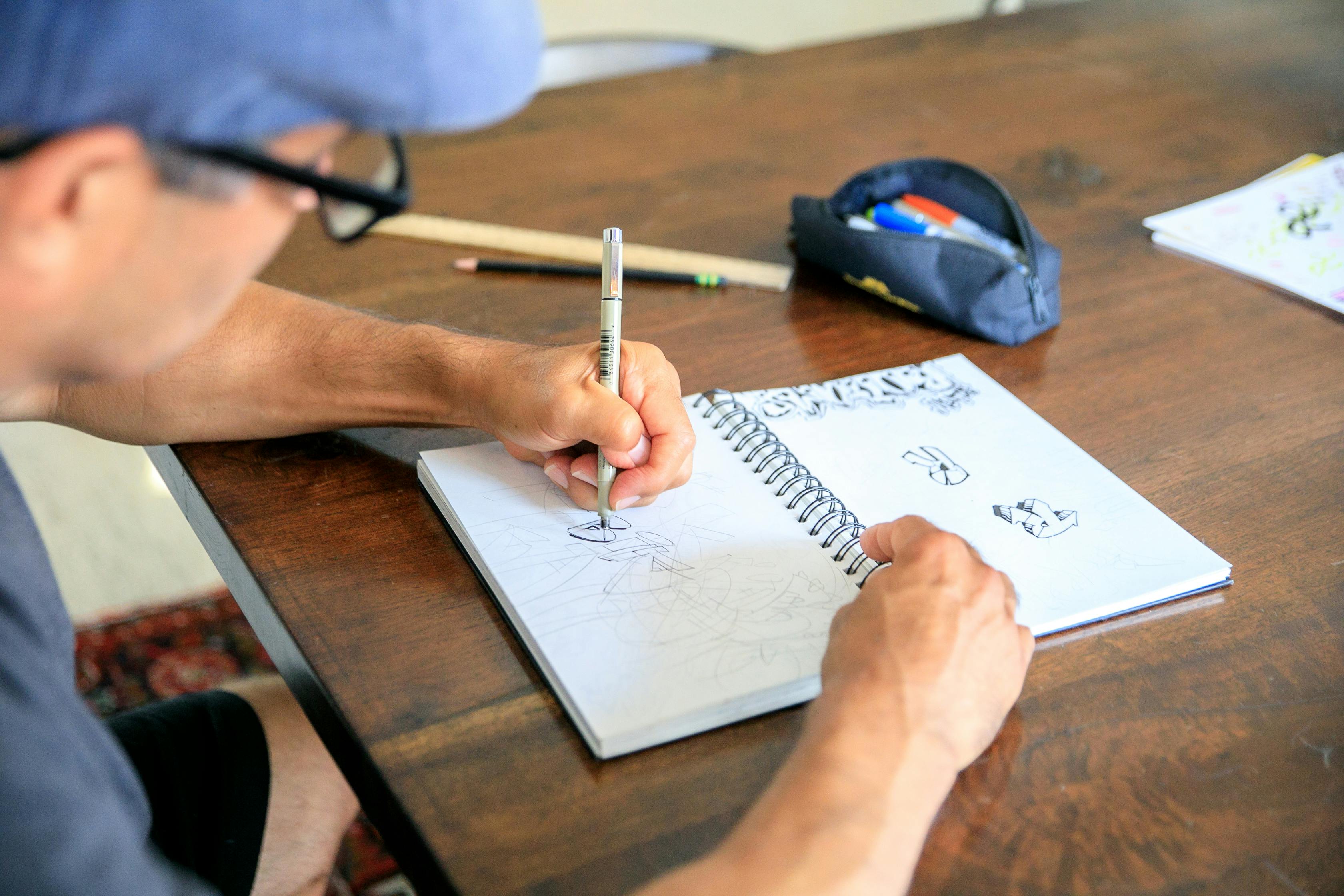
I looked for a portrait drawing workbook that actually worked. I could not find one. So I made one.
That is the short version. Here is the longer one.
The problem with how most people learn to draw portraits
When I decided to learn portrait drawing at 25, I did what everyone does. I opened YouTube and searched "how to draw a face." I got 400 million results. I watched maybe 50 of them over six months. Some were brilliant. Some contradicted each other. None of them told me what to do on Monday versus Thursday, or in what order to learn the concepts, or when I was ready to move on.
I was stuck in what I now call tutorial hell: consuming content that felt productive but produced no skill. Every video gave me a piece of the puzzle, but nobody gave me the box with the picture on it. I did not know which skills to learn first, which to save for later, or how to tell if I was actually improving. I just kept watching and hoping something would click.
Then I found Drawing on the Right Side of the Brain by Betty Edwards. That book changed everything, not because it was comprehensive, but because it gave me a sequence. Edges first. Then spaces. Then relationships. Then light and shadow. One concept built on the next.
Within 7 weeks of practicing every Saturday, I had completed 14 portraits. My total supply cost was $15. The transformation was not talent. It was having a path.
Why I built a workbook instead of a course
After sharing my progress on Threads, beginners started asking me the same question: "Where do I start?"
I could have pointed them to Betty Edwards' book. I could have made a video course. But I kept thinking about what actually worked for me, and it was not watching someone else draw. It was doing the exercises myself, with a pencil in my hand, following a structured sequence.
A workbook forces you to draw. A video lets you watch someone else draw and mistake that for learning. Research on skill acquisition consistently shows that active practice produces stronger retention than passive observation. The spacing effect, studied since the 1880s and confirmed across hundreds of experiments, shows that practice distributed over days outperforms the same amount of practice crammed into one session. A 2016 study published in Psychological Science by Mazza et al. found that spacing practice with sleep in between cut the total practice needed in half.
So I built Zero to Portraits in 7 Days as a workbook, not a course. One concept per day. Built-in exercises. Common mistakes flagged at each stage. A "done" checklist so you know when you are ready to move on. No videos to watch. No theory to memorize. Just pencil-to-paper practice, 20 minutes a day.
What makes this different from other drawing books
Most portrait drawing books fall into one of two categories. The first type is the reference book: 300 pages of anatomy diagrams, skull structures, and muscle groups. These are useful if you already know how to draw and want to refine your accuracy. They are overwhelming if you are starting from zero.
The second type is the "follow along" book: step-by-step instructions that walk you through one specific drawing. You end up with a decent copy of someone else's work, but you have no idea how to draw anything on your own. The skill does not transfer because you never learned the underlying perceptual principles.
This workbook is neither. It teaches you the 5 perceptual skills Betty Edwards identified as the foundation of all realistic drawing: edges, spaces, relationships, light and shadow, and the gestalt. But it teaches them through structured daily exercises, not lectures. Each day builds one skill. By day 7, you combine all five into your first complete portrait. The method transfers to any face, any reference, any subject. That is the difference between copying a drawing and learning to draw.
What is inside the workbook
Seven days. Seven concepts. Each one builds on the last.
Day 1 breaks the "symbol system," the childhood mental shortcuts that make every beginner draw cartoons instead of real faces. You learn to see edges and contours the way Betty Edwards taught it, adapted into a single focused exercise. By the end of this day, you will have drawn something that surprises you, because your hand is more capable than your brain has been letting it show.
Day 2 builds head structure. Before you draw any feature, you learn to place the scaffold: eye line at the midpoint of the skull, nose line halfway to the chin, mouth one-third below the nose. This is where most beginners skip ahead and pay for it later. Getting the proportions right before you touch a single feature saves hours of frustration and erasing.
Days 3 through 5 cover the individual features: eyes, nose, mouth, ears, jaw, and hair. But you do not draw them as named objects. You draw them as shapes of shadow and light. You draw the dark triangle under the nose bridge, not "a nose." You draw the curve where the upper eyelid meets the crease, not "an eye." This is the core perceptual shift that separates realistic portraits from cartoons.
Day 6 is shading. You learn to squint at your reference until detail disappears and only the big value shapes remain. Then you block those in. The biggest portrait drawing mistake I see beginners make is overworking the shading, pressing harder and harder until the portrait goes flat. This day teaches you when to stop. I wrote a full tutorial on this: how to shade a portrait without overworking it.
Day 7 puts it all together. Your first complete portrait, using everything from the previous six days. The workbook walks you through the full process from blank paper to finished face, with checkpoints along the way so you know you are on track.
Who this workbook is for (and who it is not for)
This portrait drawing workbook is for complete beginners. People who say "I can not even draw a stick figure." People who tried YouTube and quit. People who bought a Udemy course and abandoned it by day 3. People who want to draw a real face, a parent, a child, a friend, but do not know where to start.
It is also for people who drew as kids and stopped. People who always wanted to pick up a pencil again but felt like the window had closed. The window has not closed. Drawing is a perceptual skill, not a talent you are born with. If you can learn to read, you can learn to draw. Betty Edwards proved this across decades of teaching at California State University Long Beach, and I proved it to myself at 25 with an old notebook and $15 in supplies.
It is not for people looking for advanced anatomy instruction, digital painting techniques, or stylized illustration methods. It is for the person standing at the very beginning who needs someone to say: "Here. Do this first. Then this. Then this. You will be fine."
Why I called it "Zero to Portraits in 7 Days"
Because that is what it does. Not zero to perfection. Not zero to commission-ready. Zero to a recognizable portrait that you drew with your own hand, using shapes you observed instead of symbols you remembered.
I went from stick figures to 14 completed portraits in 7 weeks. This workbook compresses the core method into 7 days. The rest is practice and repetition, and the workbook gives you the structure to keep going after day 7 too.
The real reason I made this
I remember what it felt like to want to draw and not know how. To look at someone's face and feel the gap between what my eyes saw and what my hand could do. That gap felt like talent I did not have.
It was not talent. It was a method I had not learned yet.
I teach because I remember Day 1 exactly. I remember the frustration of my first portrait looking nothing like the reference. I remember comparing myself to artists on YouTube who seemed to draw effortlessly, not realizing they had years of practice I could not see. I remember the exact moment when edges clicked and my hand finally started recording what my eyes actually saw. That moment is what this workbook is built around.
If you are standing where I stood two years ago, this workbook is for you. One concept per day. Twenty minutes. A pencil and some paper. That is all it takes to close the gap.
Not sure where to begin? Start with these 7 portrait drawing tips I wish I had on day one.
Want the free version first? Grab the 5-step portrait process checklist and see the full sequence from edges to shading on a single page.
Ready to go? Get the Zero to Portraits in 7 Days workbook and start drawing today.